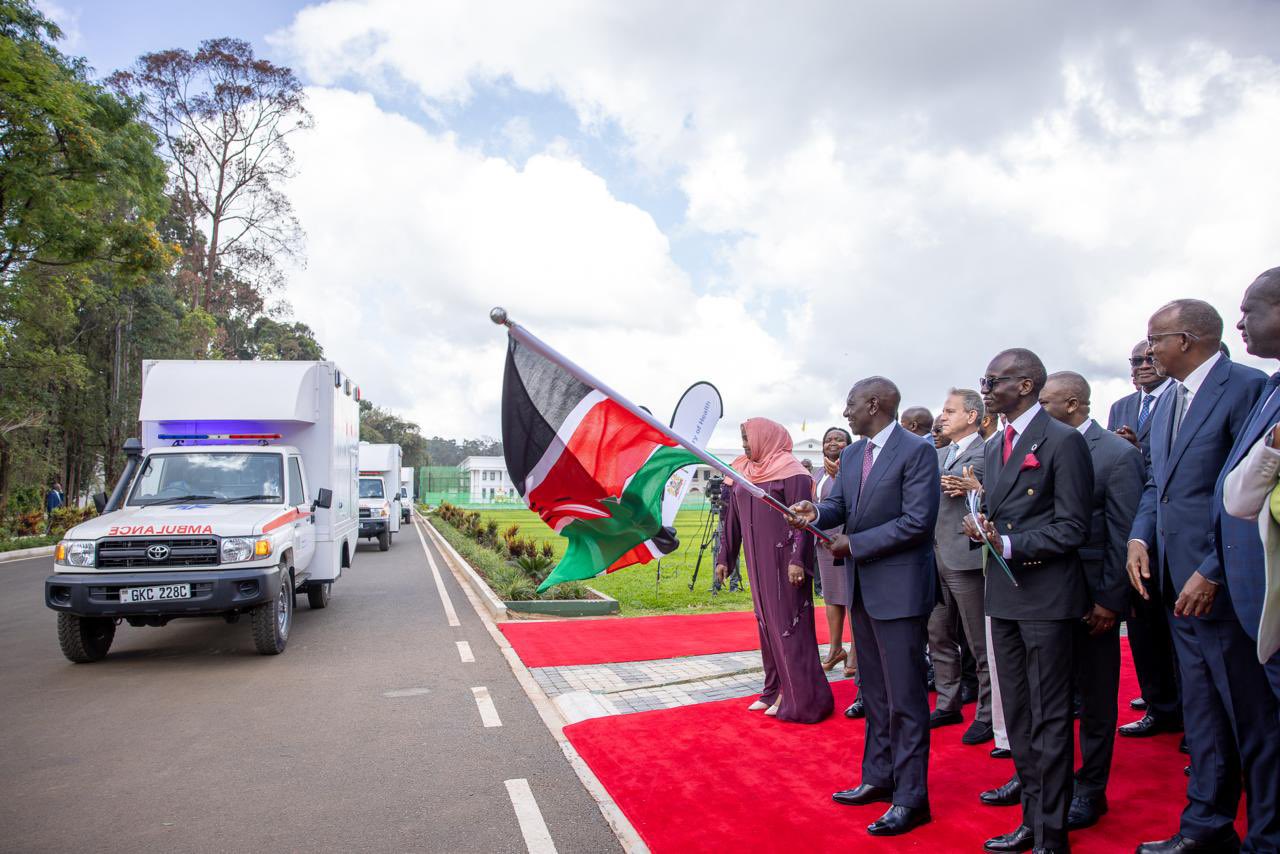
President William Ruto has reiterated Kenya’s commitment to strengthening universal health coverage (UHC), saying no woman or child should die from preventable causes in health facilities.
Speaking at State House, Nairobi, during the handover of a Sh299 million ($2.3 million) medical support package from the World Health Organization (WHO), the President said the country must urgently reverse rising maternal and newborn deaths through better data, faster emergency response, and improved frontline care.
“This support goes to the heart of our universal health coverage agenda advancing safe pregnancies, healthy mothers, thriving newborns and responsive systems,” Ruto said. “Maternal and newborn mortality in Kenya remains unacceptably high. No woman should die while giving birth, and no baby should be lost to preventable causes.”
The WHO consignment includes 14 fully equipped ambulances, among them eight advanced life support units for national referral hospitals and the emergency response center, and six ambulances dedicated to reproductive and maternal health in high-burden counties such as Tana River, Elgeyo Marakwet, Samburu, Marsabit, Garissa and Siaya.
Also delivered were five medical oxygen cylinders, nearly 3,000 emergency and infection-prevention kits, 6.5 million treatment tablets targeting 15 counties, and a comprehensive reproductive and maternal health package containing more than 950 items.
WHO Regional Director for Africa, Prof. Mohamed Yakub Janabi, said the support represents more than a financial contribution.
“Today we hand over a major consignment of 2.3 million dollars to the government and people, but this is more than a transaction. It is a testament to partnership, purpose, and the power of collective action,” he said.
Janabi emphasized that each emergency kit and ambulance is a lifeline: “Every minute matters. A mother who gets care in time, a child whose life is protected, a health worker who responds well that is what this equipment stands for.”
President Ruto revealed that hospitals will now be required to report every maternal and newborn death in real time, saying data gaps have slowed progress.
“We cannot be losing upwards of 300 in 100,000 while the benchmark is 70; this is unacceptable,” he said. “Every facility, public and private, must provide data on mothers and children who die in their facilities.”
He said the Ministry of Health has been instructed to conduct a rapid results initiative, with complete national data expected by March next year.
Prof. Janabi commended Kenya for hosting the WHO Emergency Hub in Nairobi and for its leadership in regional health security.
“A nation that cannot protect its mothers cannot protect its future,” he said. “Together, we are building a Kenya where giving life is never a risk but an experience defined by safety, dignity and hope.”































Comments
Sign in with Google to comment, reply, and like comments.
Continue with Google